The article was published in issue 3 of the newspaper Ergatis [Worker], on the 6th of October, 1947. The newspaper acted subsequently as the formal newspaper of the Trotskyist Party of Cyprus. Translated from Greek by the blog. A digital version of the issue can be located here. A Greek transcription of the article can be found by pressing here.
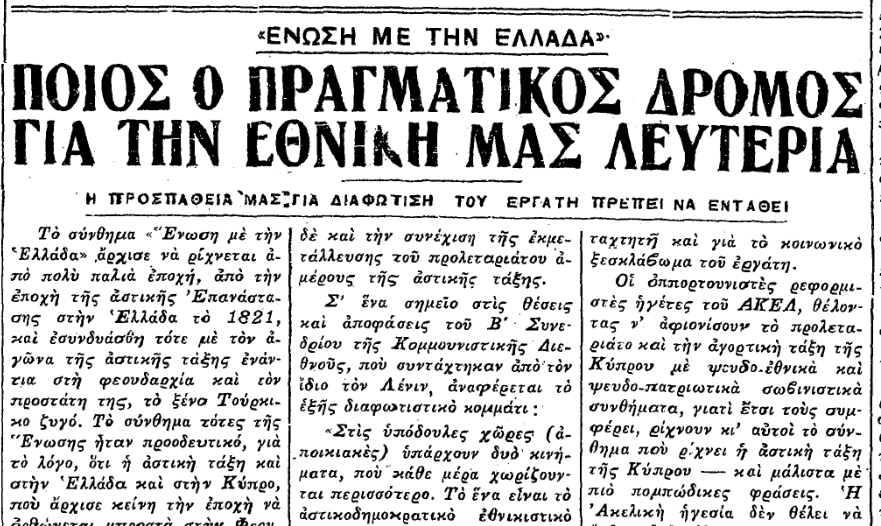
"Union with Greece"
Which is the Real Path for our National Liberation?
Our Attempt for the Enlightenment of the Worker Must be Intensified
The slogan “Union with Greece (Enosis)” began to be promoted since an older period, since the period of the Greek bourgeois revolution of 1821; and was then connected to the struggle of the bourgeois class against feudalism and its protector, the foreign Turkish yoke. The slogan of Enosis was then progressive, because the bourgeois class in both Greece and in Cyprus had begun back then to rise up against the feudal class, with one single aim: the abolition of feudalism and the expulsion of the foreign occupier, THE SAME OCCUPIER, of both Greece and Cyprus. The enemy was common, and therefore the struggle was common. Against the same occupier, against the same class. What could be better than the unification and coordination of the revolutionary powers? That is why we say, back THEN the slogan “Union with Greece” was logical, was progressive.
This slogan has continued to be promoted by the Cypriot bourgeois class and its intellectuals until today (and from the Greek bourgeois class of course, which saw in Cyprus yet another wealthy territory for exploitation). Today, however, a NEW EXPLOITED CLASS emerged to the surface, the PROLETARIAT, which asks not merely for its national liberation, but at the same time, for its SOCIAL liberation. From the beginning of its appearance in Cyprus, the vanguard of the working class, the old Communist Party of Cyprus, began to attack the bourgeois and chauvinist slogan of “Enosis”, which, while aiming for the expulsion of the foreign occupier, also aimed for the continuation of the exploitation of the proletariat by the bourgeois class.
At a point in the positions and decisions of the Second Congress of the Communist International, which were formulated by Lenin himself, the following enlightening section is presented:
“In the oppressed countries (colonies) two movements exist, which are further divided everyday. The first is the bourgeois-democratic nationalist movement, which has as its programme political independence and the continuation of the bourgeois regime. The other is the movement of the poor peasants and workers, aiming for their liberation from every form of exploitation. The first attempts to direct the second, and in many cases, it succeeds at doing so to a significant degree. However, the Communist International and the parties belonging to it must fight this tendency and make sure to consolidate class consciousness in the working masses of the colonies. For this reason, the greatest and most necessary task is the creation of Communist Parties that will organise workers and peasants for the revolution and the establishment of Soviet Democracy”.
Now, what else could the slogan “Union with Greece” be, other than a social democratic nationalist slogan, since it demands, on the one hand, the expulsion of the foreign occupier, but on the other hand it asks for the continuation of exploitation in another form, through the union with another bourgeois state - even if that state speaks the same language as us, even if that state claims that our country is a part of its territory. In its appetites, it is no different than the present exploiter. This capital, regardless of its different national name, also seeks more places to exploit, also seeks more slaves in its service. That is why we struggle both for the expulsion of the foreign occupier and for the social liberation of the worker.
The opportunist, reformist leaders of AKEL [Progressive Party of Working People], wanting to sedate the proletariat and the peasantry of Cyprus with pseudo-national and pseudo-patriotic chauvinist slogans (because that’s in their interest), also promote the slogan advanced by the bourgeois class of Cyprus and do so, in fact, through even more pompous phrases. The AKEL leadership does not want to come into conflict with the petit bourgeois class, fearing that it may lose its support in the various exploitative actions it undertakes daily at the expense of our country’s working class (doctors with enormous clientele, lawyers with plenty of business, poets, publishers and writers with an enormous circulation of their publications etc).
As for the slogan “Unity, reconciliation”, we have always condemned it and continue to do so, because it aims to disconnect the worker from her class demands and to sedate her class consciousness. Co-operation with bourgeois elements can only be carried out within the struggle for the expulsion of the foreign occupier, and this only through these three basic terms: 1) The proletariat party and the class it represents must not lose their class essence. 2) The proletariat party should lead the national liberation struggle and 3) the everyday class struggle for the economic and political demands of the peasantry and the working class should in no way be ignored.
*
Union with Greece?
The argument that through the union of Cyprus with Greece the national fetters that wrap us will be unravelled, enabling us, side by side with the Greek proletariat, to move forward towards our social liberation, is but an excuse and at least childish, because the struggle of the Cypriot or the Greek proletariat is not a strictly national struggle, constrained within the national borders of each country, but internationalist – it is the struggle of the totality of the proletariat, of the totality of the oppressed, across the whole globe.
The capitalist world has managed to remain alive until today, after the last six-year war and its post-war crisis of overproduction, by acting in an internationalist way, by helping and supporting itself. In contrast, the proletariat powers, or the revolutionary national liberation excursions of the oppressed slaves of the colonies, have nowhere succeeded in bringing a meaningful result, because they lacked the internationalist foundations for their struggle, they lacked internationalist solidarity and mutual support. The examples are numerous:
Burma, Indochina, Indonesia, Ceylon, the Indies, Persia, Palestine, Egypt, Morocco, Madagascar, Paraguay, Bolivia, Spain, Syria, Greece etc. All of the above prove to us that any struggle that is confined within the strict national borders of a country is destined to fail, because it has to face not merely its own exploitative class, but the whole global alliance of the capitalist world, which will certainly intervene to help its threatened capitalist sibling in that country (Greece, Indochina, Indonesia, Persia, China etc).
Therefore, our struggle will not be benefited if it is coordinated only with the struggle of the Greek proletariat. Out struggle must necessarily be coordinated with the struggle of all other colonised slaves, and foremost, with the proletariat of England.
Comments
Post a Comment